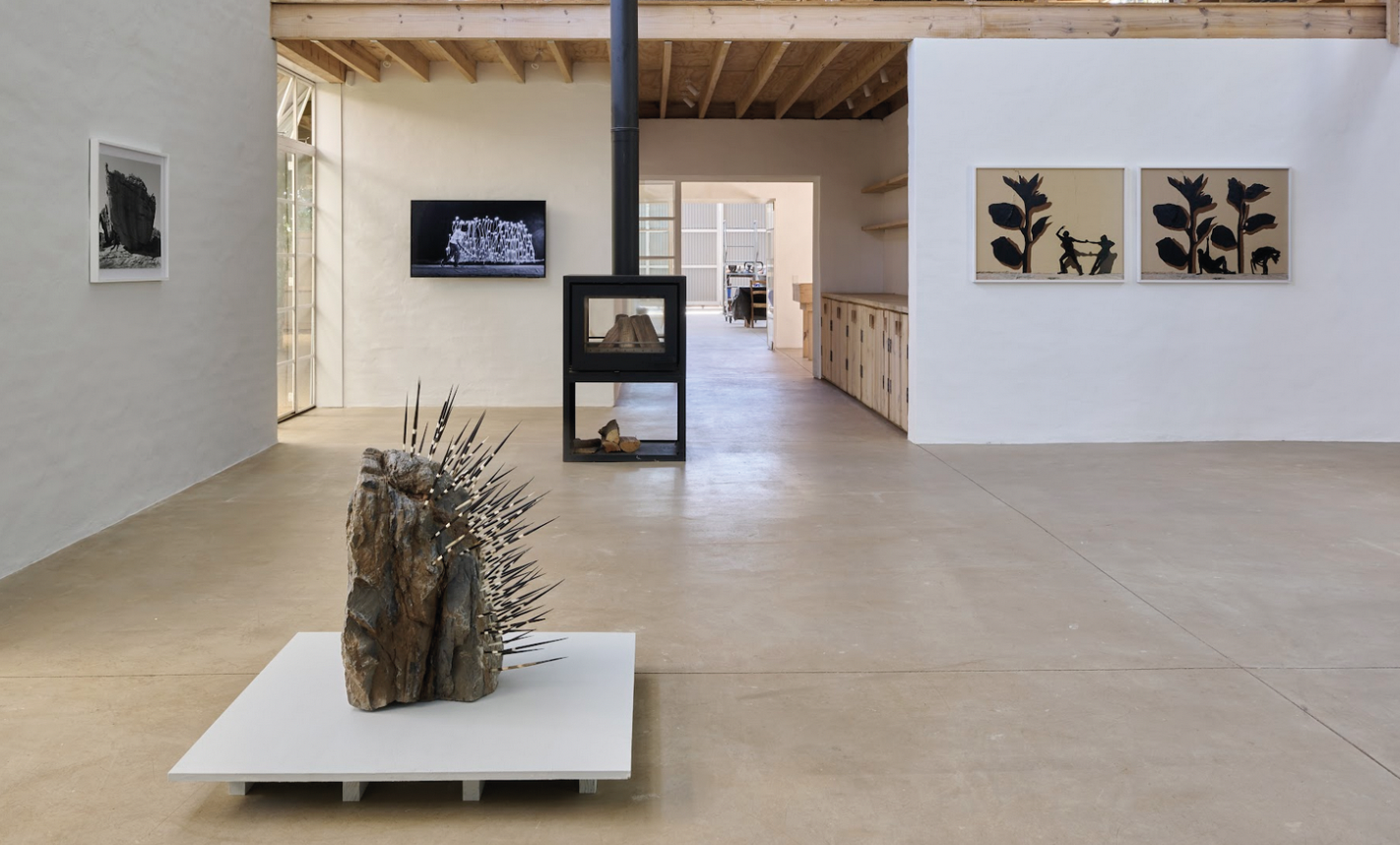
This is an edited transcript of a conversation that took place in the lead up to the exhibition Robin Rhode: Body as Sculpture, at the Villa-Legodi Centre for Sculpture (14 February – 5 April 2026). You can access the full catalogue by clicking the image below.
Light Things // Robin Rhode
Sven Christian [SC]: I want to start by asking about the act of representation—this idea that one thing can be used to represent another.
Robin Rhode [RR]: So, how do I get to this conceptual understanding of transforming an object into something else?
SC: Yes, but also more broadly, like when we think about rock art or paintings on cave walls; the idea that you can take something that you’ve observed in the world, and replicate it in a different form—say, on a wall—to become a surrogate for that thing, in its absence.
RR: It’s interesting that you bring this up. If I look at where South African artists are at the moment, everything seems so human-centric. I'm focusing on the relationship between the non-human-centric. That's the basis of animism. I'm like an animator: I'll represent a small species of flora, like the Khat flower or leaves, and paint it on a wall three meters high, transforming something small into something large and fantastical. It then becomes a surrogate for human interaction—the human interacting with a non-human-centric body. I find that dynamic really interesting. What's our relationship to the world around us? What's our relationship to a bottle of water? How does my imagination allow this bottle of water to start moving, or to have a personality? How does it begin to embody something humanistic? I think that's also the basis for ancient rock art in Southern Africa. It's like giving life to the non-human, or creating this association and deep spiritual link to the non-human, whether it's an eland or rain… We are so embedded with this human energy that we're able to create relationships and energy links with things around us. I like to explore these kinds of non-human relationships, and how they begin to interrogate ideas around class, politics, identity and so forth.
So that's like the imaginative sketch that I have in my mind. I just explore this sketchbook. It can be hit and miss. I'm not saying that I always succeed. I just have this strong impulse to make something and take it from there. I don't always have complete control over what I'm making, but I love the idea of bringing something into a tangible artistic form for the world to engage with. If people tell me it doesn't succeed, so be it. At least it’s out of my system. I’ve given the idea a life, a moment to exist. I take chances, I guess. I don't always know what the hell I'm doing, but I'm out there trying my best to make something.
SC: You used the word “relationship” a couple of times...
RR: Relationality is a big thing for me.
SC: A word like “shift” also feels applicable. Different moments of push and pull. When I think about the works on exhibition now, for example, the flower works have a radial quality that is also apparent in some of your earlier works. Here, you've used cutouts and layered them into these wall reliefs so that the forms overlap, marginally, but you can tell their momentum is clockwise. They’re still, but movement is invoked. I imagine a roulette table. With the flower works, the source of momentum isn’t as apparent as it is with the green infinity curve.
RR: Yes, exactly. It's an infinite rainstorm.
SC: The water cycle is, I guess, the ultimate form of relationality. It directly connects all life on earth. That is a central current in the Soil & Water exhibition.1 Even though it's a static image, and even though you've used variations in colour—like a darker green at the points of intersection—to create tension…
RR: Yes, I use six different shades of green to create that effect, like it's twisting. I’m trying to give it a three-dimensionality, but to give it that sense that it's actually twisting in space.
What excites me about my show here is that it's really cemented some ideas that I've been engaging with for a few years. The indigenous, non-human-centric ecosystem has become a major framework for my research. I'm really captivated by what I call the indigenous codex. When we apply the indigenous codex, we can become invisible beings. What I mean by that is, the indigenous codex is the history, the oral history of our indigenous peoples that guides us to the world around us, or to manipulate materials to make rainstorms, to help us avoid projectiles in conflict moments. Those ideas really inform my practice at the moment. I think it's a very powerful discourse because it speaks to an oral history from before colonisation. That's a major focus for me moving forward in the global discourse of art history.
NIROX has become a focal point in my trajectory, especially for exploring the idea of the indigenous codex. NIROX’s paleontological position enables me to immerse myself and explore that codex in this environment. I don't think I could do this as productively or organically elsewhere. NIROX gives me the space to do this work. I had the research, then NIROX came along, and I committed because it provides this crucial space. I wouldn’t be able to create this if I were showing in Brussels, do you know what I mean? It's like I needed a laboratory to explore these ideas, whether it's utilising rock forms, rainstorms, botany, and so forth. Berlin doesn't give me that. New York doesn't give it either. But forty kilometres outside of Joburg? That gives it to me. This is where the codex needs to be explored, so that was my approach to the show and residency.
SC: To date, the site of your work has often been urban. Of course, NIROX is between two big centres, Johannesburg and Pretoria, but you also made a number of works in the city on this trip.
RR: I did a crazy amount. I was embedded in the township scene for like fifteen years. I worked on one wall in Johannesburg’s urban space for twelve years, doing multiple pieces in intense locations. I think I have a strong grasp of South Africa's social peripheral situation. But I'm also willing to step away and explore other avenues. I think that's the best thing for artists to do, you know?
I'm still an outsider, in a way, because I'm coming from Berlin, moving in and out. I’m in this transient space between Europe and Africa, and I get to look into South Africa through an outsider’s lens all the time. It’s important to be able to do that.
SC: You shared a number of works on social media recently of indigenous flora and fauna wall paintings, accompanied by texts related to their medicinal properties. I assume these were made now, while in residence, in Johannesburg?
RR: It's all Johannesburg-based, but the framing is autonomous.
The camera never gives away the location or socio-economic codes—it could be Brazil, Barcelona, anywhere. That’s how I work. I've had interesting dialogues with creatives in Berlin who find my work difficult. They want to know more about the environment, but I’m not exposing that. I give you just a fragment of a wall with a crack, nothing more. I’m not showing the crystal-meth junkie standing next to me. The wall is a portal. It took me fifteen years and many personal and professional shifts to understand why I kept travelling into the Johannesburg township—because the walls there were a portal. It’s similar to how certain rock surfaces and shelters served the Khoisan for thousands of years. I embrace the palimpsest methodology, painting the same wall repeatedly, to reinvigorate the idea of the wall as a portal for the community and me—to go into the portal, through the wall, through the rock. Only after I’d retired the wall, sold my studio, and gone through a lot emotionally did I realise: “Oh my God, that’s actually what I was doing!” I travelled that distance, faced all that potential violence, because I needed to get to that portal.
SC: The portal analogy could apply to a lot of your work. Everything you do feels geared towards opening things up, be it conceptually, in the manner, say, of Magritte—“Ceci n'est pas une pipe”—or how you might transform a gallery into a colouring book for kids. There’s a circulation of presences, a way of breathing new life into things, places, and people. I'm reminded of Raqs Media Collective’s “Dreams and Disguises, As Usual” (2017). They write about the figure of the impostor, where disguise is both a means to manoeuvre as well as a trap.
RR: It's so interesting, this idea. My ideas align with yours there—with movement, shifting, visibility, and dreams. What I see in the art world now is the exact opposite—it’s about claiming the black body and the self; about proclaiming to be this thing. And we have to align with that. Invisibility and anonymity are rejected in favour of self-proclamation, for grounding identity and the self in this thing. There's no space for poetry, for something else to exist, so I align my creative impulses with invisibility. Even if I have to rub some muti on me to become invisible. I appreciate what you're saying.
SC: What you call a portal, Raqs calls a waiting room—a space where “roles can be rehearsed, different patois perfected.”3 It's this constant in-and-out that people have to practice in their everyday lives, especially when the demands for authenticity are so high. The sculptural works on exhibition also play with ideas of authenticity. They have a Dadaist quality—the pairing of a quartz stone with Black Label Quarts…
RR: Super Dada! I'm happy to bring Dada back.
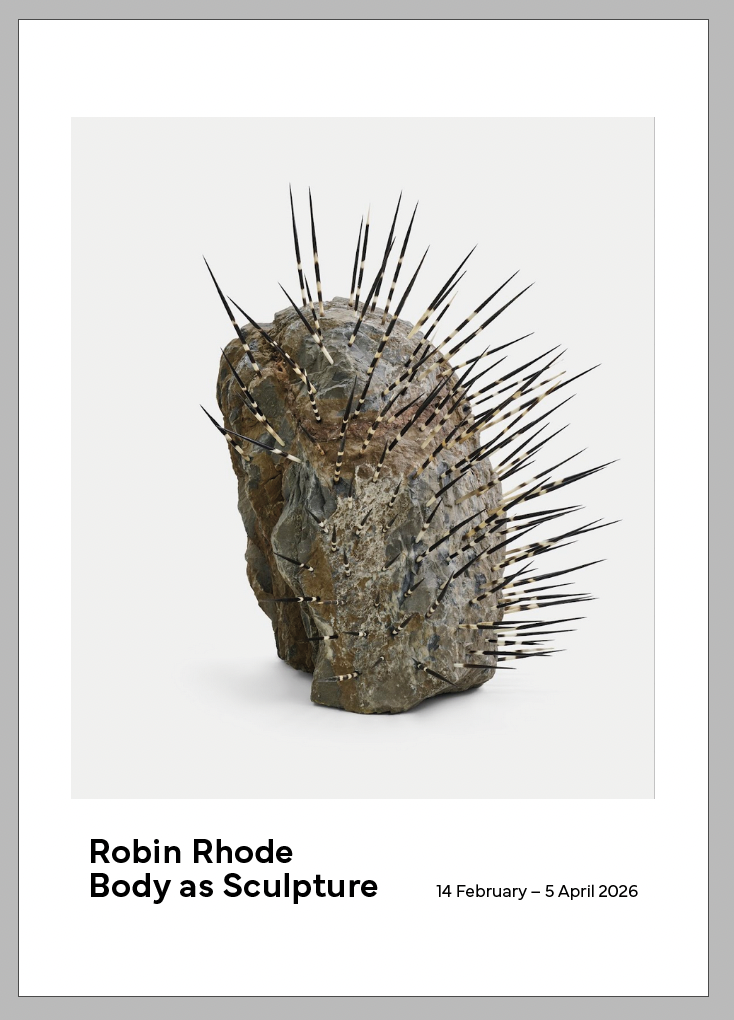
SC: With those two works, again, there's a relational thing. The quartz work has an inward force, suggesting liquid draining into the rock, whereas porcupine quills project outward. There's a certain pushback. I’m curious about how you landed up here. Is it just intuitive? The result of play?
RR: 100% intuitive. If a geological specimen can stand in for geological time, what happens when I insert modernity, this bottle? I found it extremely playful and subversive to insert an entire crate of Zamalek into this rock, this thing that holds memory. As an object, it’s also like one of those wine racks in the cellar that hold valuable wine, you know? Zamalek—the lowest denominator in the beer hierarchy—is now elevated into this pristine art object. Apparently, it’s the most expensive crate of Black Label in the world.
SC: Yeah, sure. Excalibur!
RR: Yes, it's the Excalibur Black Label beer. The porcupine piece is also super interesting. There's a text that I'm flirting with at the moment, a treatise by Goethe on stones. And Goethe inspired a lot of my botanical research. In The Metamorphosis of Plants (1790), he speaks about the metamorphosis of a plant from germination—how it becomes a mirror for our own growth. He studies flora as a form of mimicry. I guess the morphology of stones is similar. The dolomite is interesting because it’s so porous and fragile, yet in this region, it also holds many fossils. I wanted to give this fragile rock a life through animism, as if it were a porcupine standing on its hind legs. And porcupines aren’t aggressive. The quills might feel aggressive, but it only reacts when threatened. Otherwise, it's pretty chill. It just floats around, doing its thing. Maybe it’s passive-aggressive.
That's where I want to situate my ideas. In that equilibrium between something that's passive, and something that's dangerous or violent. Again, it comes down to the simple idea of animating things, of making things come alive. I love to do that. It's inherent in my work as a young artist, too, like drawing a bike and then riding it. It’s like, “Ok, I'm gonna give this dead object a life too. It's gonna move now.” I've always seen sculptures as elements of animism. Sometimes it works, sometimes it doesn’t. I work with that basic framework and apply it to different contexts. That for me is the cutting edge, the fine line. It can either fuck out or be sensational, but I exercise my intuition by placing myself in those environments.
SC: It's a very theatrical approach, like how an actor might use a red nose to become someone else entirely.
RR: Or a disguise or mask or something.
SC: The object can be animated, but can animate in turn.
RR: I always wonder where these impulses come from. I don't think I learned it in school. Maybe it comes from something that was planted in me at a very young age, like watching Charlie Chaplin—seeing something on TV as a kid and realising it'll be fun to make bricks fall from the sky. I don't know what it is.
For example, I can reach out and touch this empty teacup. Without taking my hand away, I can then walk around it in a circle. It stays in the same position, but I’m moving around it, so suddenly the human experience is magnified over the object. The object is still there, but we give it meaning, and that object can dictate how we navigate the world around us.
SC: There’s a work of yours that I was fascinated with. I think it was called Vanishing Points?
RR: The Point of Vanishing (2012/13). It’s actually very mechanical. I was looking at antique sketches of optical studies, retinal studies. And we modified a pair of swimming goggles by threading strings through the eyes and attaching them to the wall. It's looking at this colonial sailing ship. But again, super playful. There's a lot of humour involved, jokes, like giving my doppelgänger that yellow fishing jacket, while still exploring the representation of a colonial ship on a wall.
SC: There's a lot happening there that's hard to articulate.
RR: I find it hard to articulate, too. The difficulty with articulation is our motivation to understand. What makes us want to read, to explore, to experiment? If things are too easily articulated, maybe that prevents intellectual exploration. I don't think we have to understand everything. There has to be space for further experimentation.
It's a long road, you know? I've been doing it for twenty-five years, and I always feel like I'm back at square one. Like, I worked my butt off at NIROX, as if it were my last or first show, out of respect for the South African audience. I feel I have a responsibility. I was highly, highly focused and motivated, as if I were performing at MoMA. It has to be world-class. I have to push for great works and great ideas.
I'm from this period in South African art, the late-‘90s, where we took risks and did stuff spontaneously. I want to maintain that spirit. Like, I've done shows with big production budgets, but I still want to pursue this level of intuitive practice and take risks. I'm not sure what I'm doing, but I'm going to try to evoke a ship by interacting with that rock formation and still speak about the poetry of that photograph…
SC: I tried to imagine what effect your photographs on the exhibition would have if they were in colour—how different they would be.
RR: You know? I think colour is maybe too sexy. The black-and-white reduces it a bit.
SC: It's the disguise thing again?
RR: Yes, I disguise it a bit. More so, the rock. With colour it becomes so saturated, so seductive. Colour would also locate it, would tie it to the Cederberg. In black and white, it can be anywhere. I try to flatten it, to keep it in the realms of documentary photography.
My point of reference is 1960s performance art. I'm working with rocks, but it's going to be like Dennis Oppenheim 1972 or like Vito Acconci 1970.
SC: And yet, you’ve referred to the saturation and colour of an artist like Sol LeWitt as an inspiration for some of your geometric wall-based work. There, you use colour optically to suggest movement.
RR: Yes.
SC: David Hammons is someone else you’ve referred to. I think about African-American Flag (1990), and how that simple intervention—replacing the white, red, and blue of the US flag with the black, red, and green of the Pan-African flag—could take something so iconic, so sedimented in its meaning and representation, and open it up to a world of possibilities. Such manoeuvrability seems like a strategy you adopt often. It’s like what you were saying about having to maintain the freedoms that come with experimentation in your practice—treating this exhibition like your first or last.
RR: Yes, one-hundred per cent. It continues into everything that I do. Sometimes it’s difficult to come up with good ideas or make work. I don't think I'm the most productive in the studio. I find myself completely lost. I don't think I necessarily make the best work there. My best work, my best ideas, come from being out in the world. I don't know if I always respect the materials, as a traditional studio artist here does. They find a material, and they're really good at it. I don't want to elevate the material. It’s not like I only work with rocks, and then my thing is to sit and carve and chip away.
I also have this very complex relationship to intense labour. I take the Dada approach, the Duchampian principle. It works really well in South Africa. I'm surprised artists here don't adopt it more, given our vibrant political and material history. I work hard, but when you see my work, it mustn't look as if I worked. Some artists like to expose the intensity of their labour because it defines the quality of their work. I prefer a counter-labour aesthetic. Like Duchamp, I counterbalance things, making the heavy things light and the light things heavy—playing with those value systems, rendering expensive materials obsolete or turning a simple object like a Black Label quart into something extremely valuable.
South Africa is such a rich space for those kinds of games. This is where David Hammons comes in as a powerful influence: he plays with the idea of labour intensity and value systems.
I can't be this traditional artist in the studio, chipping away at a piece of marble or carving wood. I'm not disrespecting those artists at all—I appreciate craft, it’s so important—but I'm not good at that, so I'm not going to do that for all time. I don't have that patience, unfortunately. I have to move a bit more, be a bit more fluid. I adopt a different approach. I'm just not geared towards being confined to a single space for a long time or to a single material.
SC: Douglas Gimberg spent some time in residence with you.
He's got a very strong understanding of material processes and has learnt how to fast-track labour processes, for example, making stone-work more efficient. I would have liked to be a fly on the wall for your conversations with him about labour, materials, and process.
RR: Yeah, Douglas is a master of his practice, his materials.
He can manipulate materials with his tools. Our conversations were initiated through NIROX and the Villa-Legodi, and it was great to have someone like Douglas—who’s worked with these rocks—to help guide my understanding of the material and to help implement my ideas, like bringing together these foreign entities, these beer bottles and quills and these rocks. Understanding the material was important, so Douglas played a necessary role in facilitating this dialogue and helping me understand the tools and what they entail—like, this is what is required of me to make that. It was laboured, it was tough, literally grinding rocks, having to pay attention to the dangers involved, but I can't do that all the time.
I'll hop onto one thing, make that, then make something else. I struggle to be confined to one thing for a long period.
SC: You were also engaging students at one point during your residency.
RR: Yes, I really enjoy it. It allows me to sit with my thoughts and ideas. Being able to share this oral dynamic with a group of young people was productive for me, and I hope it was for them too. I always place myself in their shoes and try to be engaging. When you meet an artist, what does that artist give you? It's interesting, it's fun. That's it.
SC: I appreciate what you were saying earlier, too, about the direction of artistic production in South Africa today—the sense that it’s a bit stifled. It seems like there's a lot of economic pressure for artists to sell.
RR: Let's just say there are fewer risks being taken, both in South Africa and internationally. The idea of experimentation doesn’t come to the fore so much anymore, but this is why we don’t always have to follow the tide. South Africa has always been a benchmark for the international art world—they've always looked back at South Africa for interesting, dynamic artists. So we should continue exploring and challenging these economic demands. There are multiple approaches we can take, but it's also about education and exposing young artists to alternative realities, alternative modes of production.
SC: I guess invisibility, or anonymity, can be useful here too. When your identity is not so tied to the things that you produce, you can play more and find yourself through them.
RR: Yeah, absolutely. I think it should start at the institutional level, too. Like, lead us sometimes, you know? It's very domestic. When we move outside of our comfort zones, interesting things happen. Certain things open up. Let's walk through Johannesburg and see what happens, you know? Let’s go to the mountains and be still… I miss South Africa so much, and I've been so inspired by it. I loved my visit to the Sterkfontein Caves and all these stories. When I share my experiences with my friends and sons here in Berlin, about Homo Naledi—how we weren’t alone… “Guys, don't you know what the hominids are?” My son is fifteen, and he's using that for his next oral exam at school. He's going to speak about Homo Naledi. He's like, “No way!”