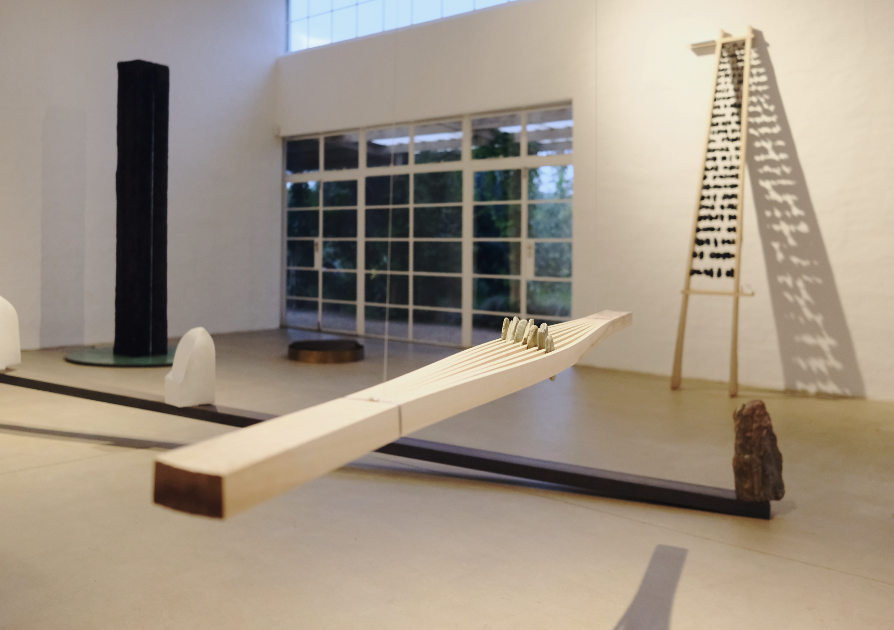
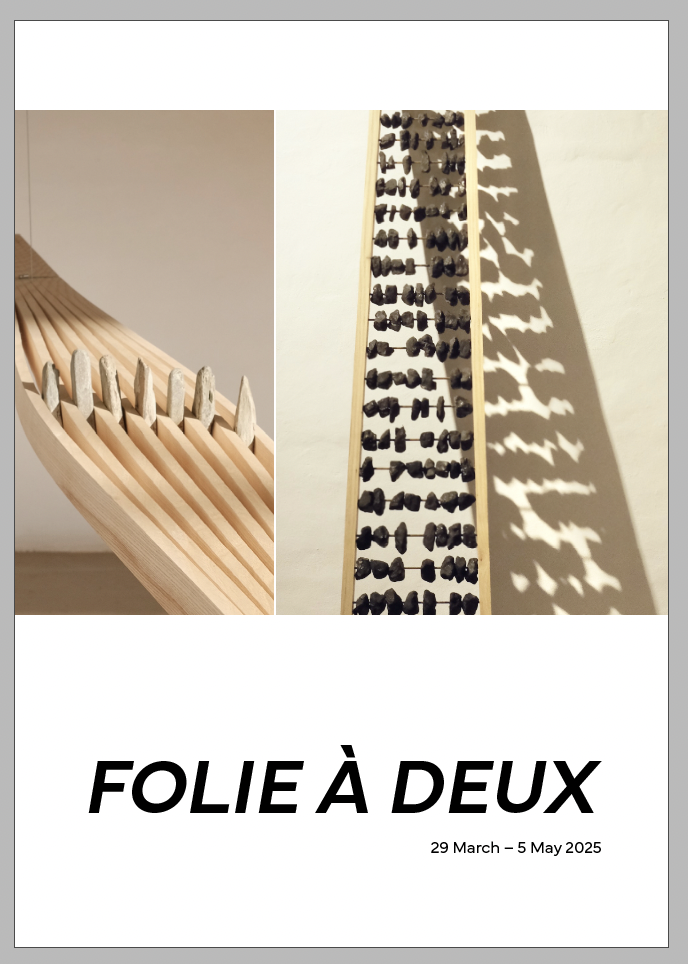
This is an edited transcript of a conversation that took place in the lead up to the exhibition FOLIE À DEUX, at the Villa-Legodi Centre for Sculpture (29 March – 5 May 2025). You can access the full catalogue by clicking the image below.
FOLIE À DEUX // Diana Vives and Douglas Gimberg
Sven Christian [SC]: This conversation is intended to introduce new audiences to your work and to tease out some underlying currents — those that we already know about and those that we don’t.
Diana Vives [DV]: I’m equally curious to see what will become of the collaboration between Douglas [Gimberg] and me during our residency, because we are very aligned, in terms of how we see the world. Of course, there are a few departures, but Douglas has taught me craftsmanship and he’s also a sounding board for everything I make. It’s not that I follow his every advice, but I involve him in my process. It’ll be interesting because Douglas keeps his process to himself. Only when it’s done am I allowed to see the work.
SC: Is that because you want to retain some sense of magic, in the encounter?
Douglas Gimberg [DG]: That’s a big part of it. It’s wonderful when the object can appear as a surprising addition to the world. If you present the work afresh, with minimal context, you can see whether it does what you thought it would. Diana is my first point of contact in that sense. There’s also a utilitarian aspect to my work, which often means that the final aesthetic is not necessarily cohesive; a composite of different objects, materials, and formal associations which might have evolved significantly in the making.
DV: Whereas I probably do seek an aesthetic quality, although not at the expense of meaning — I would only sacrifice the aesthetic if it’s necessary for the work.
SC: Douglas’s description feels appropriate to your work too, though, in terms of the material associations or staged relationships that you set up. There’s an alchemy that happens between objects or materials which we may have inadvertently replicated in the exhibition, by pairing your works. Could we chat a bit about the exhibition title, Folie à Deux?
DV: Folie à Deux is a term from psychiatry. It's a shared psychosis, in which there's a contagious delusion. In French, it's used more loosely to describe a very complex — sometimes destructive — emotional relationship between two people, likely a couple, who are always engaged in love and conflict; anything that generates enough friction to create either a downward or upward spiral. The spiral is an important form, too, because it underlies the growth patterns of the universe and this idea of escalation and evolution, but also cycles.
SC: Like the energy that two opposites create — some kind of whirlwind?
DV: Yes, although Douglas and I are not opposite forces. We’ve had a lot of thoughts in anticipation of this residency, more so than the exhibition, insofar as that’s a more curatorial exercise on your and Tristin [Roland's] part, bringing together existing works that you identified and have a relationship with, so it doesn’t need to be polar opposites, but it is a different charge. It’s energy and dialogue.
Friction is generative: in Hindu mythology, Agni is a Vedic deity who represents this. The Vedas describe his creation by the friction of his parents, who are two kindling fire sticks, and he eventually consumes them, so fire harbours all of these powers of transformation — sexual, emotional, spiritual, physical, material… As Bachelard outlined so well in The Psychoanalysis of Fire (1964). Today I was thinking about what we want to say through the work that we will make in residence. We don’t want to make a so-called eco-project, yet nature and culture are central to how we relate to our work and materials. To be an artist today and not deal with those themes is almost impossible. I’d say I'm more environmental, whereas Douglas is maybe more political.
DG: Politics is not a general theme in my work. Specific works are political, like The Revelation Machine (2022), which is a participatory piece that I’ve brought up for the workshop. There is a big question about the state, ownership, and the destruction of land. It asks what all of this activity is from the Earth’s point of view — where is the edge of a given territory if the substance of it is no longer there? With The Revelation Machine, it’s about picking up stones that one finds in the land, breaking them open to expose them to our world, and searching for something inside.
DV: Douglas will break a stone and say that’s breaking down the land, fragmenting it. I break a stone and go: You’re looking at time immemorial. It’s a great example of our different ways of reading. But when you say political — and I think what happens environmentally is political, so that’s not a contradiction — there is the greater cosmic history of our planet and its indifference to humans. So I guess, in Folie à Deux, we’re looking at the Earth as a kind of ticklish Gaia; I can’t remember who used that phrase, but it’s this idea that she might just wish for humanity’s destruction, because of how we act. Actually, I think it was Isabelle Stengers who used that notion, to reframe the Earth not as a passive backdrop, but a sensitive, living presence which is unruly and reactive and demands that we rethink our modes of engagement.
SC: In your master’s dissertation, you write about the transformative and destructive capacities of fire, and the very personal story of being in Brazil and watching a high-rise burn down. There are various ways in which fire acts as a catalyst for change. Could you speak to this?
DV: All three of my works on exhibition are about processes of transformation, although two relate more closely to fire: one uses a beam I found in a lumber-yard after a fire, and the other uses anthracite, the cleanest and hardest form of coal ... a deep-time fossil remnant of primeval plant matter which we are burning, literally igniting the Earth’s deep past to power the present.
But my project is less about its destructive power than about trying to rehabilitate perspectives on fire, not as some rogue element in the Anthropocene, but as something biotic for which humans have carried great agency since the agricultural revolution, through industrialisation and colonialism. New materialist thought adds a nuanced emphasis to this. It’s a progression from my interest in the histories and metaphors that matter holds — and the accounting for it over time; the way that it has formed and transformed through use, and also accounting not just for its extraction from the Earth, but the idea that we consume in the way that fire consumes. We consume, yet we are left with a waste product that is also part of the transformation.
I talk a lot about time and the scientific and metaphoric properties of the materials. My intention is always to unify. When I started researching my project, I was looking for an origin myth and I found it in fire. As I said in my dissertation, it’s in language, but it’s also in the body, as a thermodynamic and thermoregulatory system, and it’s contagious. It’s about the object over the word for it. Then there’s the cognitive development that underpins the acquisition of controlled fire. It gave us the ability to cook food, it enabled the transition to ground sleep, which allowed us to dream in REM states. It gave us community around the campfire and developed storytelling and working memory. It lit the way into caves for the first rock art that was mediated by shadows. So fire is even more in my mind now than in my materials. I am even more aware of fire as a metaphor, but also as a state of contagion in a process of transformation — in that sense, of course fire is in Folie à Deux.
The work which looks like an abacus and a ladder is called On Conservation of Matter (2023). It sets the tone for this idea of vital matter, matter in constant flux. The anthracite that make up the abacus beads, and the shale in Weir, are the oldest materials in this exhibition. Anthracite formed over millions of years under intense heat and pressure. That’s earth matter. Then there’s the ladder, which is compromised, precarious, and finite. I guess the work suggests that no matter what you accumulate, count, what you do, how high you ascend, there’s death, but that we still continue to transform after that.
To your point about fire as a catalyst for change, while the former work contextualises human endeavours within a constant process of transformation over cosmic timescales, Artemis (2023) and Sphinx (2024) are almost like an Alpha and Omega in the human use of fire as a tool. Artemis refers to the natural fires for which the tree struck by lightning was the first conduit, and the idea of regeneration — the regrowth that occurs after a forest fire, coaxing new life out of the earth, and for which the ecological term is 'secondary succession'. This connects back to the ancient vegetation divinities. Apart from Artemis, the goddess of wild nature, Persephone and Demeter were chthonic deities from the underground realm. And to the ancient Greeks this underworld wasn’t about death — they understood that this is where you conjure spring, regeneration. I really like that idea, which is why the base of the sculpture is green, and between the beams you can make out a porcelain pomegranate, which is the symbol of Persephone.
Also, as a beam, it has transitioned from one economy to another, from nature to culture, so to speak. I always found this quite interesting in the works of Giuseppe Penone. He would look at a beam and didn’t just see human construction, but expose the sapling in the tree. Artemis is about all of that, but it all started with the harvesting of fire from the mind. All other animals shrank from fire, yet the human was drawn to it, to harvest it, to kindle and coax it.
Sphinx is also composed of beams, but refers to the threshold of a completely different age of information technology, the digital future, and effectively the human hybridity with AI, whereas Artemis is the beginning — the transition from natural fire to controlled fire and everything that it set in motion, including art making.
SC: What you’re saying is interesting in relation to Well (2021). It will be paired with Artemis, which, for me, has a totemic quality, like a conductor or conduit. Well is more contained. It has that reflective capacity, which relates to the psyche in some way. It makes me think of Narcissus. Then there’s the utilitarian aspect alluded to in the title.
DG: The round form consists of brass rings that are deliberately offset to introduce a precarious quality which a seamless cylinder wouldn't achieve. The frame suspends the stone above the sheet of glass. It took three successive rings to achieve the necessary height. On one level, I’m interested in the precarity of the way the triangular sharpness of the rock hangs like a heavy guillotine blade of sorts above the fragile glass, almost touching it. And I've cut and polished the sides of the rock to expose the blackness of its interior — a volcanic plume that hardened in the Earth’s crust. I chose to make the well's reflective surface black - rather than mimic water in some other way - in order to create a visual connection between the stone and water, as well as to evoke impossible depth. This connection is enhanced by the pitted oxidised surface of the rock which attracted me to it in the first place, and evokes an erosion by eternal rain, like a record of eons of water shaping rock.
DV: Yes, like raindrops on the surface of a lake. It’s remarkable to try think about that process of erosion and how long it must take. There’s a tension between our understanding of the hardness of the stone in contrast to the softness of that undulating watery impression. To then contrast that with the well-like structure, as a vessel for the collection of water for man’s use, or a resource that needs to be managed and controlled and stored and utilised...
SC: Something about the deep space-black of that base feels anticipatory. It’s a bit unnerving in its stillness.
DG: And it's interesting that you refer to Narcissus, which was a consideration and mirrored my romantic desire to connect those natural elements by having the formal similarity of the blackness of the stone reflected in the black reflective pool. The idea of a black portal is very important; a darkness that you don’t want to penetrate. Nor can you fathom its depth. It’s foreboding, and it doesn’t just reflect. It feels like depth.
SC: With Artemis it’s the inverse, right? It has a light on the base that shines and creates a sense of depth, this silhouetting presence.
DV: Yes, one goes up and the other goes down. The implication in Well is about what sits below the surface, whereas Artemis is more about what pushes up from beneath — both share the ground as a meniscus between the two realms.
DG: But Well is more about time; not knowing how long it would take to fill up, the time and uncertainty of the rain. It’s reassuring that it doesn’t really matter what happens in the lifetime of humanity. The one thing I should say is that I started thinking about Well around the time of the day-zero scenario in the Western Cape; the management of our water supply. At that point there was a very heightened fear around our use of water, which did feed into the work.
SC: As a title, Weir also suggests a redirection or intervention in the flow of something. There is an aspect of time being present in the warping, too, or how the shale sits in gaps to create that sense of tension. Then there’s their sequential placement — like the reference to an abacus in On Conservation of Matter. Can we talk about the accounting aspect of these works? The incisions made in Sphinx also feel like the counting of days. In Weir it’s a compression or some other account.
DG: Yeah, there’s a process which is then mediated by an event — the interruption of stones. Then there’s a restoration to the original state. The implication is like Brancusi’s The Endless Column (1938); this thing that is expanding and contracting, that’s part of an infinite process. The only caveat is that I painted one end of the Ash blue — a standard method for grading timber. I also wanted to include this colour so that people make an association with water on some subliminal level.
A weir just consists of piling up some rocks and gradually moving further and further across the stream, picking rocks up off the shore and putting them into the water. It’s a small intervention, but it can have big consequences, either because it widens the river and slows it down, making it easier to cross, or it widens the river and makes it shallower. Then you can access the fish more easily.
DV: Talking about water and fire, there’s the creation of the planet as fire and the idea of stars as heavens on fire. Life on Earth only became possible through water. Fire doesn’t really hold a memory, either, it's more that matter holds a memory of its transformation through fire. But all of the water that has existed on earth is part of a hydrologic cycle and it holds a memory.
SC: Looking at Weir, you must have placed the wood back together very carefully so that the parts that the rings create a kind of rhythm, like when you pluck a guitar string and it vibrates. That vibration travels outward but is also the result of an event or intervention.
DG: Yes, exactly. It was important to make it obvious for viewers that it is a single piece of wood, cut into a number of strips; that it wasn’t an arbitrary accumulation of strips but one thing.
DV: Well, you don’t think of it as cut. You think of it as this intact piece of wood that’s being forced apart.
DG: I have a more industrial association, but yes, it impacted certain decisions. Cutting it on the bandsaw is not the right way to do it; if you want even cuts, you use a tablesaw. The bandsaw blade is half the width of the tablesaw blade, so you lose less wood, but you also get this ripple pattern, such that the two halves register against each other because the tooth creates a keying system which meshes the strips back together in a way that wouldn’t have happened if they were cut with a tablesaw. And I would have lost more of the wood with each cut, compromising the visual continuity of the grain.
SC: In the past, you’ve chosen to display it on the floor. For the exhibition we spoke about it being suspended, but you haven’t placed it vertically on a wall, and that’s intentional. I’m wondering about the horizontal aspect of the work?
DV: The sadness is that it’s really most beautiful if you lie on the floor and look at it, because it’s actually also a scale.
DG: The idea was that it would form a balance in the distribution of the stones, relative to the weight of either half of the beam.
Diana is right that it’s most beautiful when you can actually see that. Most people view it from the top so they see the splay, but if you look at it from the side you see something else. I still think it should be presented at a height. I like the idea of it on this fulcrum — that it rocks back and forth. It has to do with how one moves things around. When you’re moving heavy objects you try to find a way for the earth to hold the bulk of the weight, so that you can deal with the smallest weight possible. You find ways to walk these objects around by putting in a fulcrum at one point, so that you’re now going to engage with just half of the weight of the object.
DV: That’s kind of where the idea of Sphinx standing on these little feet came from.
DG: A very different balancing occurs with Endeavour too, with the fake rocks elevated in their progression along a continuum. The tension of balance is simulated in the bowing of the pallet under the weight of the beam, which is also faintly slumped, suggesting the weight of these forms accelerating in frequency as they near the edge of an insignificant precipice.
SC: You write that the shale used for The Revelation Machine and Aqueduct comes from the ruins of District Six. Diana, you’ve also worked with remnants, for example, with burnt astronomy charts from the Jagger Library fire of 2021.
DV: Yes, the burnt wood that I used for Artemis comes from the fire seasons of Philippi. They have terrible fires every year. But before I forget, you were talking about the verticality of my work and the horizontality of some of Douglas’s works, and about the flow in his. And it’s true that when I look at the formal properties of his work there’s always a sense of flow; not in the psychological sense, but the idea of motion. Whereas when you described Artemis you used the word "totemic", and I do see how it appears to be in a state of pause, arrested in a particular state, although my concepts are about constant transformation and flow.
A group of works that I made in 2020 — Nobody, Nowhere — were all about things negotiating with change and gravity. But balance isn’t always inert. It’s sometimes a tension between forces, what you would call equipoise in physics: a state of rest due to the equal action of opposing forces, like people pulling a rope from either end. They’re pulling at the same time, with the same strength. So it’s a precarious balance, easily lost. Precarity is very important. It’s one of the main things being tested in each of our sculptures: the sense that the object or situation is not necessarily stable.
DG: One of the most appropriate subjects of sculpture in general is how it defies gravity in some way, defies its physical constraints. The heaviness of objects is part of their meaning, part of the properties you leverage to get people to relate.
SC: In Sphinx, that sense of stability / precarity is created by leaning them against each other and the wall. Endeavour also reads a bit like dominoes. I want to flick one and watch them all go doof, doof, doof, doof.
DV: Exactly! Not to say that my works are an illustration of physics or astronomy or whatever, but I’m always looking for something more. So here, in physics, energy isn’t destroyed, it just reconfigures. And the same could be true of thoughts, emotions, and consciousness, not in a mystical way, but as a part of an intricate, ongoing metamorphosis. Ideas cycling through minds, matter dispersing into new forms, information living on in unexpected ways. There's an embrace of transformation, not as a comfort, but as a fundamental truth, indifferent to human existence, yet still inevitable and even perhaps sublime. If the universe is indifferent, then meaning isn’t something given. It’s something we create, something that emerges in the way we respond to change. recognising impermanence and still engaging, feeling, thinking, and creating. And it made me think of Camus. You remember when you recommended that wonderful book, Create Dangerously? The idea of embracing life’s absurdity, not with despair, but with a lucid rebellion. If everything transforms, then maybe our role isn’t to resist change but to shape it, to find beauty in the way that things shift, dissolve, and reconfigure.
SC: I like what you said about information living on in unexpected ways, too, like the marks on Sphinx: they read like the incisions found in Blombos Cave, for example. That stage of technological invention. In Endeavour, the cuts made to give these objects their form make them look like gems. There's a quality to the mark that speaks of a different technological age. They're so crisp and clean that you almost don’t recognise it as a mark anymore. They have an industrial quality.
DG: There’s also the failure of information, insofar as the object is a limited reproduction of the original.
SC: Diana, you spoke about the desire to unify things, but with Sphinx the feet seem to move in a different direction?
DV: Absolutely. Sean O’Toole asked me the same question. He said, 'Why do you have three figurative works in your show'? I carved the feet of Sphinx myself and had them cast in bronze. Here it’s about the relationship to the title and the Sphinx, but it’s also about future hybridity, or a current hybridity and this idea of emphasising the contrasts in the transition from animal and human — and even perhaps the animistic — to the digital and supposedly immaterial, as we become more and more influenced by new technologies.
I was also asked that question about figurative accents by Nkgopoleng Moloi in the walkabout to my show The Fire in The Mind. A lot of creative work doesn’t come from rational and abstract thought alone. It also comes from things that well up in our subconscious. Part of that is something we access through dreams. Although our dreams may be absurd or violent or bizarre, we always dream figuratively. There’s something there. The imagination is figurative. We then transform it into something less or more so.
SC: I saw them as the more insistent aspects that relate to mythology, but also to the solidification of an idea or story.
You mention the imagination, our investment in different stories, or how they become simplified and adapted as they're passed on. But in your work, a dissolution happens. The feet of Sphinx point to the singular, whereas the columns disperse that. There’s the solid and the not solid, the certain and the uncertain, balance and precarity. But Douglas, have you ever made figurative work?
DG: Yes, I have four self-portraits at the moment in concrete.
There’s a fifth one coming, which incorporates a figurative element. But at the same time they’re abstract. So each consists of a concrete element, which relates to my proportions. The concrete wedge which you've seen at our home stands on a pair of shoes. Another incorporates a hat. There’s one with a glove, and there’s one with a rope belt and a pocketknife.
SC: How do you see those works sitting alongside, say, Weir or Well?
DG: Each of them is a placeholder for my singular relation to the world, which is expressed in the other sculptures. They also incorporate stone, which is a central interest at the moment, and explore its relationship to concrete, as "our" kind of stone: human stone. What’s amazing to me is how concrete goes from cement and aggregate, mixed water, to a fluid and then a solid. So that’s very consequential to me, as it is the opposite to the mechanical action of water on stone which results in a breakdown and sedimentation.
To end on an optimistic note: in Endeavour, the interval between each stone on the beam, is half that of the next. For example, the beam is six metres long and the space between the first and second one is three metres. Between the second and third it is 1.5 metres, and so on. In my mind, that logic places it on the spectrum of infinity. It’s a piece of an infinite continuum.
DV: Yes but for me, the way you’ve positioned the beam could invite it to be read a certain way, because one could arguably proceed from the original stone to its replicas - so it doesn’t feel like infinity; it feels as if the space gets tighter and tighter, and at some point would lead to fragmentation or destruction.
DG: Well no, because the halving is, in this case, obviously within the physical constraints of stones. Like cell division. But the theoretical ideal is very present.
DV: Do you find that optimistic?
DG: I guess not, but it connects to the splitting of the stones, which are theoretically infinitely divisible, and ultimately, if the space can no longer grow, the piece has to become smaller or something.
SC: Some kind of sous rature. It reminds me of what we were talking about at the beginning, in terms of fire as being both destructive and regenerative. X marks the spot, that moment of transition where something goes from being one thing to becoming another.