This is an edited transcript of a conversation that took place in the lead up to Matheline Marmy’s open studio in NIROX’s residency (19 September 2026). The residency was supported by Pro Helvetia Johannesburg. You can access the full catalogue with images by clicking the image below.
Open Studio // Matheline Marmy
Sven Christian [SC]: Your portfolio is full of references to photography, which I didn't expect.
Matheline Marmy [MM]: I did photography for years, I studied it during my BA. My approach was more conceptual. For me, photography was an entry point: while interested in the image and its impact, I soon felt frustrated with the two-dimensional aspect of it. Our studies were very focused, I lacked the process of making and felt like there should be other ways to be able to express an idea or address a particular place.
Towards the end of my studies I made an installation with printed objects onto space; a photographic series that revolved around a ruin in Fribourg canton, Switzerland. The idea was to evoke the shape of this ruin or reconstruct it through photographic means, while reinterpreting it. I was also interested in the shift between the micro and macro — to have the objects seen from above and then seen in reality, evoking a shape to be completed. I ended up reconstructing images with tape in the lab and in the field, while remaking my own objects in the studio and photographing them, playing with these constructions.
Later I started to experiment with objects or surfaces that act photographically, but aren’t necessarily photographic. I began experimenting with metals and minerals, things that would react, not with light, but through corrosion, oxidation, temperature, humidity. From there I started to develop works that revolve around water as a carrier for change — to embed that in the works, to have the change activated on stage. My sculptures started to become really open-ended, because they would oxidate or evaporate over the course of the exhibition. I’ve done a lot of research around this idea of what carries change and how it is enacted within materials. My role in these works is to establish a triangular force between me, the material, and the activity of materials. In that sense, it’s less authorial and more process orientated.
SC: It feels fitting that even when you began working in a typical photographic fashion, your subject still revolved around time — a ruin. You also mentioned bringing those elements “on stage”?
MM: I wanted them to be more alive or active, to address time and its process, which isn’t easy to depict. Instead I focused on spaces where it could be activated, where I was one of the viewers. At the same time, one must note the ‘situation’ is not necessarily made for a viewer nor author: it’s made for itself. So the goal of these works is not figuration but the thing itself, an indexation of sorts.
SC: Photography of course has its own associations to time, but it's often more about freezing time, capturing the moment, as opposed to things that are considered active or ongoing, even though photographs are themselves physical objects, produced through, and subject to, the elements.
MM: In the history of photography, there’s this idea of fixation — photography as the key to a moment or as an entry point. In Camera Lucida (1980), Roland Barthes writes about the relationship between photography and dreams. He writes about this entry into the moment not only as a souvenir, but as a way to stop death, as well as his frustration with photography’s incompleteness — its inability to fully represent those who it depicts. Today, my work has an indirect link to photography. It's not something I necessarily want to address as a direct reference, but it is dormant in my methodology — the way that I put things together and why; the superimposition of gestures that I would use when trying to make a photograph.
SC: That reminds me of Self-preservation (2021).
MM: Yes. That sense of continuity, but also illusion. It’s called Self-preservation because I used oxidation on copper hollow bars, as a way for the metal to actually protect its core from being attacked further while changing colour and becoming blue. It was interesting to think of corrosion as a defence mechanism, something that is associated with organic life; and the visibility of the corrosive process makes it more alive. All the rods were corroded over different periods: some for ten minutes, others for thirty minutes, etc. So the idea of indexing time within this rod is present in the work and its oxides.
SC: You’ve mentioned “indexing” twice now. Earlier, I was reading a text about the Memory Float series (2025). The author, Eva-Maria Knüsel, writes about how the works were installed at intervals, to invoke a clock. Setting up these constant variables feels like something a scientist would do?
MM: I guess it's about finding a way through the materials that ultimately makes sense within a contained environment or an exhibition. I also think of some of the sculptures or installations as systems. It is self-referential, a contained system. I'm trying to create certain parameters so that this environment can take shape and operate. I guess it’s also just how my brain functions — trying to make sense of a certain set of materials and what they can do together; trying to make other things and materials enter this constellation I create at a slow pace; trying to set up situations with specific materials at play.
SC: I guess if you want to assess what has changed over time, you need something to remain constant, for comparison.
MM: Regarding this sort of scientific methodology, I prefer it unresolved. I did converse with chemists and geologists over the course of several projects, but when I make, my goal is not to resolve a specific research question. It’s rather about borrowing and maybe subverting certain gestures that I've seen in the lab, or certain ways of addressing things. It has been a challenge to think through whether, and how, I want to be in touch with these knowledge spheres, which operate like fortresses.
SC: There’s the poetics of your work, too. For example, your site-specific intervention Solid Wavers (2021), where this welded stainless steel structure serves as a container for this heap of copper wire, or the dual sense of control / letting go that takes place in your textile-based works, where the chemical reaction takes over and becomes the protagonist.
MM: Sometimes it can appear quite closed off. In Absorbed: Hazardous Growth (2021), I replicated a system I’d seen in the lab by including vessels in which bacteria could grow, as it would in non-saline European lakes. The idea was to enact a slow contamination of these spaces within the work. Simultaneously I was borrowing elements straight from the lab. For instance, the cotton wool was used to close the vial to prevent other bacteria getting in, but it was also permitting the flow of air. There was a question around temperature too, because exhibition spaces aren’t necessarily climate-controlled. Sometimes there would be good results with this growth and other times it would be a disaster and the bacteria just wouldn’t develop. So chance and letting go play a big role.
SC: These works remind me of thermometers, but there are others, like Conteneur (parasite) (2020), which for me resembles a drip, like those found in hospitals. Georgia Munnik wrote a great text about that work, where she describes these blue veins and the use of copper sulphate to kill algae and snails and so on. It reminded me of the first essay in Lucienne Bestell’s Except for Breath, where she writes about the process of death, decomposition, and a morbid curiosity / repulsion toward corpses:
To begin with the liturgy of death. To begin at the end, to begin with the deep blue marks of lividity blooming against pale skin. […] regardless of how you die, or when, or under what circumstances, your body will conform to the same processes, follow the same order of events, begin to decay in much the same way as every other body. Death seldom deviates from its course. […] Although lividity begins at the moment life ends, it is only clearly perceptible an hour or two after death, appearing as a spreading, tenebrous bruise. Lividity is assigned the fourth stage of death, where the first stage describes the pallor of the recently deceased, the second, the body's cooling to the ambient temperature, and the third, the chemical changes in the body that cause it to stiffen. One, two, three, four. In that order and never otherwise. Death is pedantic: palomortis, algomortis, rigomortis, liver mortis, ad infinitum, amen. […] The lesson continues to the last stage of death, the stage that has fallen out of faith. Among living, without euphemism and now no longer in Latin, decomposition. It is only the bodies that go undiscovered that are allowed to arrive at this final stage above ground level. The forgotten bodies, overlooked and unobserved.
MM: I think that is very powerful, this sense of in-betweenness.There are many stages — it’s not just life and death. And you have death in all things, I don’t believe death is only destined to organic bodies.
SC: In your own work, that in-betweenness becomes evident, at least in the documentation of works like Conteneur (25) (2025).
MM: I’ve done three iterations of that work and it is one I like to re-explore. It is a work that contains and directly adresses a multiplicity of ideas I’m working with. This specific version was displayed on the terrasse of a gallery apartment in Geneva, Sonnez et Entrez, and was therefore subject to heat, rain, sun — all of these uncontrollable meteorological aspects. The work, basically, is a bath containing a chemical reaction called displacement reaction. The bath of dissolved copper sulfate in watery suspension starts out as azur blue. I place a steel wire at the beginning of the exhibition in that bath — it is a very performative work — and as the steel touches the copper sulfate, this loop reaction occurs. The copper re-solidifies around the wire in its pure form (Cu) and the iron dissolves as ferrous sulfate. The process ends up with copper being solidified in and around the steel wire, while the wire is dissolving, forming ferrous sulfate which is green-gray. In this exhibition, as the weather was warm, it completely dried out, and the wire would appear disintegrated, a bit like an archaeological artifact. I like the long durational performativity this specific piece carries.
Glass is also a material I’ve started to work with in recent years. It’s not a mineral, but it adopts some mineral’s characteristics. No Prospect for an End (2026) is the most recent work where I integrated glass casts, containing powdered materials also present in the textile and steel sculpture series, Memory Float.
The solutions containing copper sulfate and silver nitrate were integrated while casting the glass over the course of multiple hours. In the form of powder, as nanoparticles diffuse within the glass, these minerals have optical properties that give the final glass different tones and hues, depending on light diffraction. That is a process at play in traditional stained-glass. The intention was to have glass core samples that would also look electrified or connected to each other. I also wanted to have colours coming from the same materials used differently — forming a kind of loop in the show — in all these different forms, in addition to an underlying sense of long durational activity.
SC: The wires also make it look like a ticking time-bomb. A bit like how you've got the wall-hanging works distanced at intervals. I start to think of a countdown or metronome, whereas, with the more recent works, like Reste (2026) or Lifespan (2026), it seems like there’s a shift towards biomimicry; barnacles, snails — things that have their own organic, almost identifiable shape.
MM: Yes, those shapes in my point of view oscillate between the mechanical and the biological realms. The intention is bring this series into a space where the shapes have their own form of evolution, as the sculpture develops itself in space and time. In the previous show we mentioned, some forms come from nineteenth-century watch parts — instruments that attempt to contain time. Simultaneously, they themselves mimic flowers or animals rendered in ornamental ways. Some reference shells, so you have this double representational space, and I wanted to play with these different levels of interpretation.
SC: There was also an excerpt of text about Excroissance (2026), by Maddalena Mora, which describes something similar:
By allowing a form to develop through repetitive, near-obsessive gestures across multiple sculptural techniques, this circularity evolved through plaster, latex, wax, and then cast bronze. Without becoming a fixed or representational entity, this multiplication slides from the natural toward the mechanical: it can evoke flower buds while also recalling overheated, non-functional ventilation systems.
At the same time, she says that the term excroissance “carries an initial negative association: something that appears in the wrong place. And yet, it may simply be a departure from a predetermined path — one that can become a surprise, an opening toward things seen differently.”
MM: In that exhibition, Excroissance, the architecture of the space itself constituted a strong starting point. It is situated in an old garage, with mould on the walls. You can paint over the mould after each show, but of course it comes back. I wanted to play with the humidity in the room as an agent in the show. Excroissance as a word, a concept, is also interesting to me because it's something that grows in the body and it’s associated with all sorts of unhealthy spaces.
SC: A lot of bats roost in the caves around here. A while ago, LeRoy [Croft] went into one. He ended up getting histoplasmosis — there are these spores in their droppings that release easily, for example, if you step on them. If you breathe them in, like he did, then they start to parasite your lungs, growing inside of you. He had to take antifungals for six months.
MM: A worrying story, but fascinating in the way that he became a host for a new entity. It makes me want to think more about the body itself as a site of containment.
SC: There’s also a poem by Ingrid de Kok, a well-known South African poet, called “Histoplasmosis: a guide's instructions at the cave” (2009), which she penned here. She writes:
If after a few weeks you find yourself coughing,
your chest laced in a corset of steel,
tell your doctor you were here.
Tell him about the bats, their investment in the
dark,
their droppings spongy fudge,
which you probably tramped on in the cave,
the spores you may have breathed
now inhabiting your lung tissue
taking all your breath
for the growing fungus
inside you.
Don't panic. There is medication for this
if you reach an informed doctor early enough.
Your airways can be cleared again,
lungs restored to normal size.
But remember, a bat flew into your body
out of a cave. Your body is now a cave.
Your breath is the way in and out of the cave,
its dark entrance the same as
its only exit.
MM: So good. It's like a space within a space, and your body becomes part of that. It's not that the space where Excroissance took place was necessarily a cave; but maybe it was on the verge of becoming one, with all this humidity and damp and black mushrooms on the walls.
SC: Maybe this is a good time to talk about your research trip in 2022, and your interest in geological time. It’s said that this area used to be underwater, that it was once a seabed.
MM: This also reminds me of another field trip I made to Switzerland in the Jura mountains, where we'd find remnants of thirty-metre long fossils of corals. It was also underwater, within a glacier.
To go back to the trip in ’22, at first I clung to this idea of rocks here being so old, and how the mountain formations in Europe are so young, comparatively. I wanted to tap into that, to gain access to these rocks. The first trip was a bit of a miss on that level, as the oldest rocks are around Joburg and Kimberley, not necessarily in Cape Town. Back then, the research of ten days was also thought as a collaboration with fellow artist Antonia Brown. Together, we met with John Rogers, a geologist who put me in touch with his colleague, Jock Robey, specialised in diamond history and working specifically in Kimberley, so I had this intention to go to Kimberley in the future and continue that research thread. This time, I got the opportunity to visit the Kimberlite Research Group, housed at UCT, focusing on research on kimberlites, mantle xenoliths, and diamonds. I met with Geoffrey Howarth there, a scholar and associate professor. Gold, diamond, and other high-value minerals are not necessarily something I use or would integrate directly in my work, but I am definitely interested in the geological process of their formation and their extraction.
SC: They definitely took a lot longer to develop than to extract…
MM: For me, it’s more about understanding how a landscape has developed and changed over time around this specific mineral formation. Interestingly, that history and passion around diamond extraction is apparently about to change radically with the development of perfect lab-grown diamonds. And it has been fascinating to try to get a better sense of the general cultural interest in this stone: a hard, transparent, lucid, revelatory stone. And how it has been marketed.
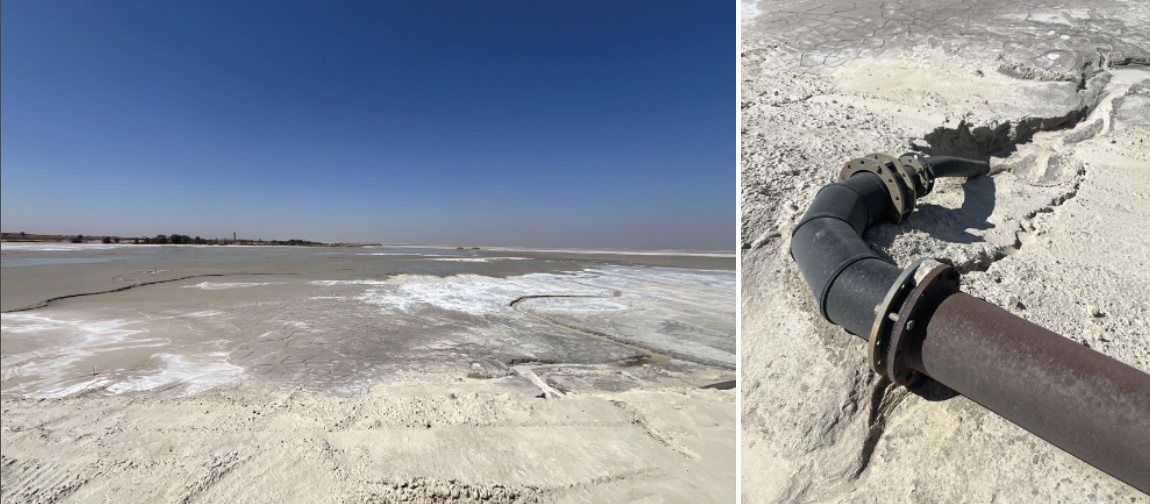
After my trip in Kimberley, conducted with fellow artist Christopher Littlewood and under the guidance of curator Amy Watson, I also visited a set of gold mine dumps around Johannesburg with Mariette Liefferink, CEO of the Federation for a Sustainable Environment, a local NGO. We went to "properly managed" dumps. These places allow visitors, which gives you a sense of where we're situated. Around these man-made piles of materials, the dust is actually the most dangerous aspect, as uranium is extracted along with the gold. When we visited, the winds were really strong and we could really sense we were inside the dust, that it was everywhere. Interesting to note that distance in terms of kilometres doesn't mean everything, as they even found this specific dust in Australia. That's how much it travels, and how insidious it is.
Around the dump, if you look at the ground there, you wouldn't necessarily sense that it's either toxic or radioactive. It’s actually really having its own raw beauty, and if no one told you, you might even think that has been how the area was naturally formed. So, there's this appeal to a toxic space that actually looks seductive, as a landscape - this doubling of danger and seductiveness. There’s something fascinating around that tension.
Then there's the fact that these dumps were have also been used as construction material. There are all of these layers of geology, extraction, construction — something being formed over millions of years and then extracted and then compacted and used for different purposes.
SC: Insides and outsides, where the surface becomes a way to read?
MM: Like an indexation, that I was mentioning earlier. An aspect is visible on the outside, but secretive processes are simultaneously happening on the inside. Micro and macro relationships, the cave in the body.